
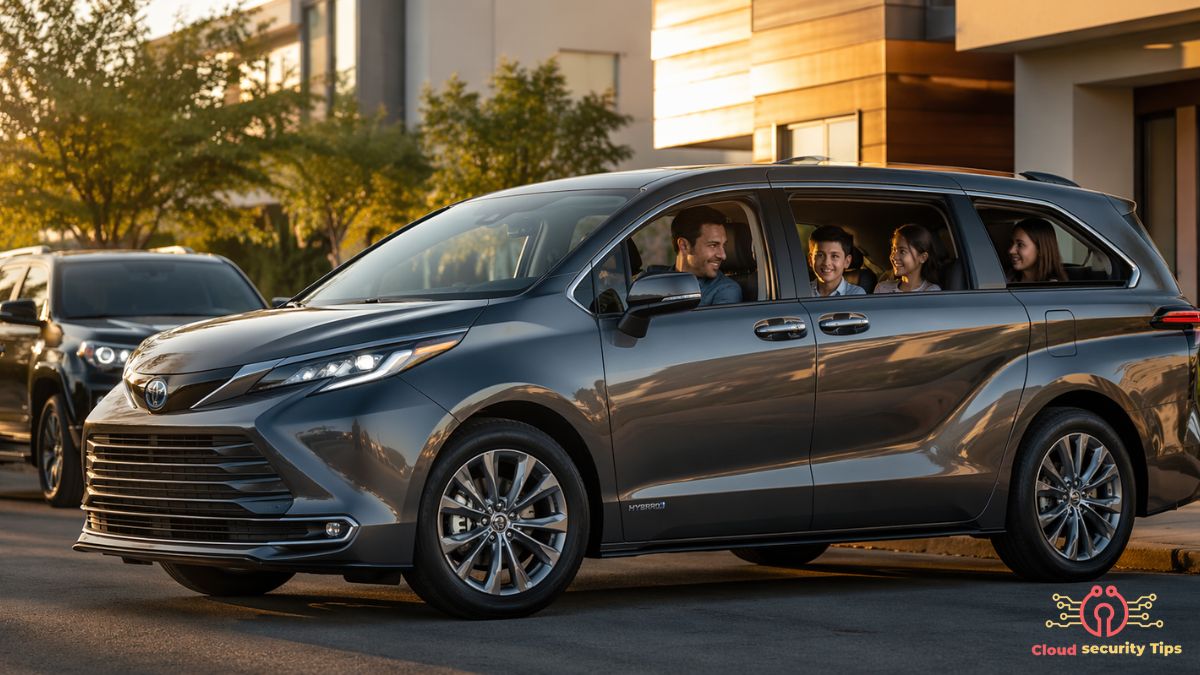
The 2025 Toyota Sienna is often categorized as a minivan, but that label fails to explain its real role in today’s automotive landscape. In practical terms, it represents a direct response to the growing inefficiencies of modern SUVs when used as primary family transport.
For years, SUVs have dominated the family vehicle market based on perception rather than pure functionality. Higher seating position, aggressive styling, and branding around “safety and power” have shaped buyer decisions more than actual usability metrics. However, real-world ownership patterns tell a different story—fuel consumption increases significantly in city driving, third-row usability is often compromised, and interior space efficiency declines when all seats are in use.
The Sienna positions itself against this gap, not by competing on styling or performance, but by redefining what “functional family mobility” actually means in daily use.
The Shift From SUV Identity to Practical Mobility Engineering
The 2025 Toyota Sienna reflects a broader shift in automotive buying behavior where utility is beginning to outweigh perception. Modern families now evaluate vehicles based on cost efficiency, interior usability, and long-term ownership stability rather than exterior presence.
Traditional SUVs were not originally designed for dense urban family logistics. Their design priorities focus on stance, towing image, and all-purpose branding. This creates inherent trade-offs in fuel efficiency, maneuverability, and interior optimization.
The Sienna addresses these limitations through a fundamentally different design approach:
- Space-first interior architecture
- Hybrid-only efficiency system
- Accessibility-focused layout instead of styling-driven form
Sliding door configuration eliminates access issues in tight parking spaces. Lower floor height improves entry and exit across age groups. More importantly, the interior is designed so that all three rows remain usable under real occupancy conditions rather than theoretical capacity.
Hybrid Powertrain Behavior in Real-World Conditions
The 2025 Toyota Sienna is powered by a 2.5-liter four-cylinder engine paired with Toyota’s hybrid system, delivering a combined output of approximately 245 horsepower.
This setup is not designed for performance appeal. It is engineered for consistency, efficiency, and load stability across mixed driving environments.
In urban traffic conditions, the hybrid system plays a critical role. Electric motor assistance reduces strain on the gasoline engine during stop-and-go movement. This results in smoother low-speed behavior and reduced fuel consumption compared to traditional SUV platforms.
At highway speeds, the system transitions into a stable cruising mode. Power delivery remains linear and predictable, prioritizing comfort over acceleration response. Even with passengers and cargo, the vehicle maintains consistent performance without noticeable strain.
Refinement is one of its strongest characteristics. Steering behavior is predictable, braking is smooth due to regenerative systems, and cabin noise remains controlled under moderate acceleration.
This reduces long-term driver fatigue in repetitive use cases such as commuting, school transport, and extended travel.
However, it is important to be clear: this is not a performance-oriented vehicle. Acceleration is moderate, and driving engagement is intentionally limited in favor of efficiency and predictability.
Interior Design Focused on Functional Usability
The interior of the 2025 Toyota Sienna prioritizes function over visual complexity. Unlike many SUVs that emphasize digital styling and premium visual presentation, the Sienna focuses on real-world usability across all seating rows.
The second row provides strong comfort levels, especially in captain’s chair configurations, making long-distance travel more practical for families.
The third row is a key differentiator. Unlike many SUVs where third-row seating is restrictive or uncomfortable, the Sienna provides usable space for both children and adults during extended journeys. This shifts its role from occasional seating to fully functional passenger capacity.
Cargo space is equally practical. With seats folded, the flat loading floor allows for efficient storage without awkward space fragmentation. This improves usability in daily tasks such as grocery transport, luggage handling, and family travel logistics.
Technology integration is intentionally balanced. The infotainment and connectivity systems prioritize stability and ease of use rather than excessive feature density.
Fuel Efficiency as a Structural Advantage
Fuel efficiency in the 2025 Toyota Sienna is not a marginal improvement—it is a structural advantage created by its hybrid architecture.
In city environments, electric motor support reduces fuel consumption during low-speed driving cycles. This creates measurable efficiency gains in high-frequency usage scenarios such as daily commuting and short trips.
On highways, efficiency remains stable even under full load conditions. Unlike conventional SUVs where fuel consumption increases sharply with weight, the Sienna maintains consistent energy distribution through its hybrid system.
This stability directly impacts ownership behavior by making travel costs more predictable and reducing long-term fuel variability.
Interior Usability vs SUV Design Limitations
The key difference between the Sienna and traditional SUVs lies in usability engineering rather than appearance.
SUVs often prioritize external design and road presence, which can introduce inefficiencies in cabin access and space utilization.
The Sienna avoids these limitations through functional architecture:
- Sliding doors improve accessibility in tight spaces
- Easier third-row access reduces user friction
- Simplified seat movement improves daily usability
These factors collectively improve real-world family usage scenarios such as school transport, urban driving, and long-distance travel.
Safety Systems and Reliability Framework
The 2025 Toyota Sienna includes Toyota’s established driver assistance systems, such as adaptive cruise control, lane assistance, collision prevention, and blind-spot monitoring depending on trim level.
Beyond safety technology, its hybrid system is built on long-term reliability engineering that has been refined across multiple Toyota generations.
This contributes to:
- Lower mechanical wear over time
- Predictable maintenance cycles
- Strong resale value retention in secondary markets
Competitive Position in the Market
The Sienna competes with the Honda Odyssey, Kia Carnival, and Chrysler Pacifica.
- Honda Odyssey: Strong traditional performance, but lacks hybrid efficiency
- Kia Carnival: Design-focused SUV-like styling, weaker efficiency consistency
- Chrysler Pacifica: Hybrid option available, but weaker long-term reliability perception
The Sienna does not rely on dominance in a single category. Instead, it wins through balanced performance across efficiency, usability, and reliability.
Long-Term Ownership Value
The 2025 Toyota Sienna performs strongly in long-term ownership due to reduced brake wear (regenerative braking), stable hybrid maintenance cycles, and consistent fuel efficiency across usage conditions.
Combined with strong resale value retention, it becomes a predictable long-term ownership asset in the family vehicle category.
Final Evaluation
The 2025 Toyota Sienna does not rely on emotional appeal or performance positioning. Its value is defined by consistent functional performance in real-world family mobility scenarios.
It does not replace SUVs entirely, but it exposes the inefficiencies of SUV-based family transport when measured against practical daily usage.
Its strength lies in efficiency, usability, and long-term stability—factors that increasingly align with modern search intent and real-world ownership priorities.