
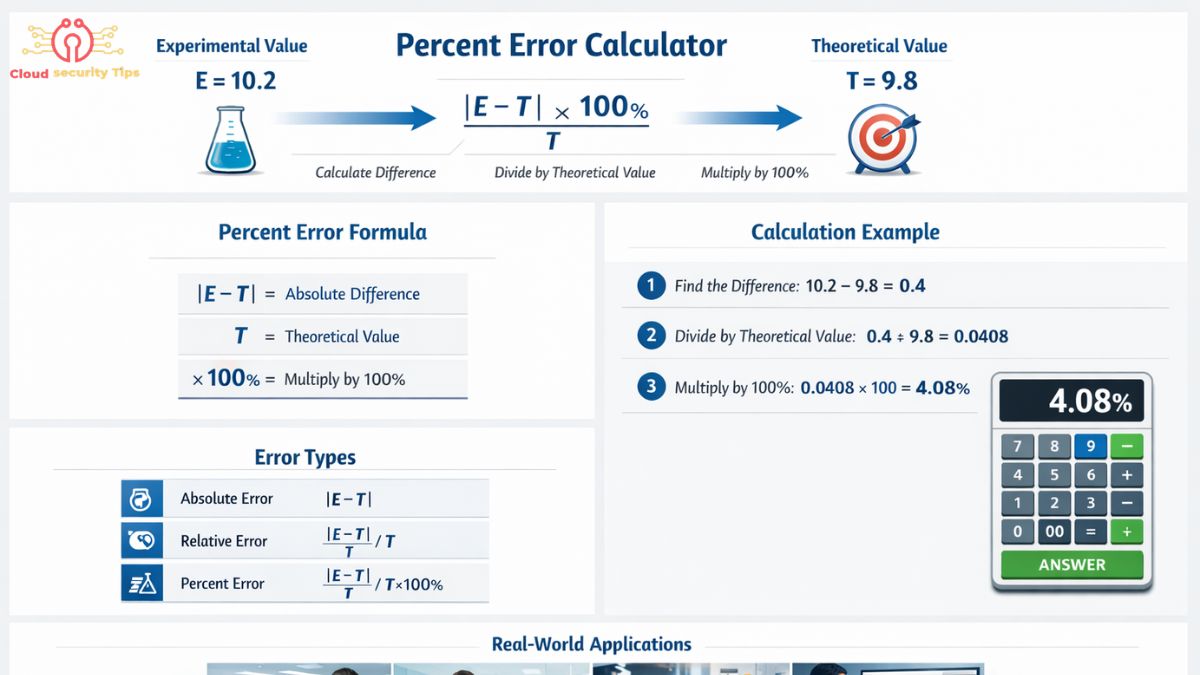
Percent Error Calculator
To calculate percent error, use the standard formula:
Percent Error = |Experimental Value − Theoretical Value| ÷ Theoretical Value × 100
For example, if your experimental value is 10.2 and the theoretical value is 9.8, the result is:
- Difference = 0.4
- Divide = 0.4 ÷ 9.8 = 0.0408
- Multiply = 4.08%
The percent error is 4.08%
This formula works for all types of measurements, whether in science, engineering, or data analysis.
What is Percent Error?
Percent error is a method used to measure how far a measured value is from the true or accepted value, expressed as a percentage.
Instead of showing just the difference, it converts the error into a percentage, making it easier to compare results across different scales.
A smaller percent error means the result is closer to the true value, while a larger percent error indicates a bigger deviation.
In simple terms, it tells you how accurate your result is.
Percent Error Formula
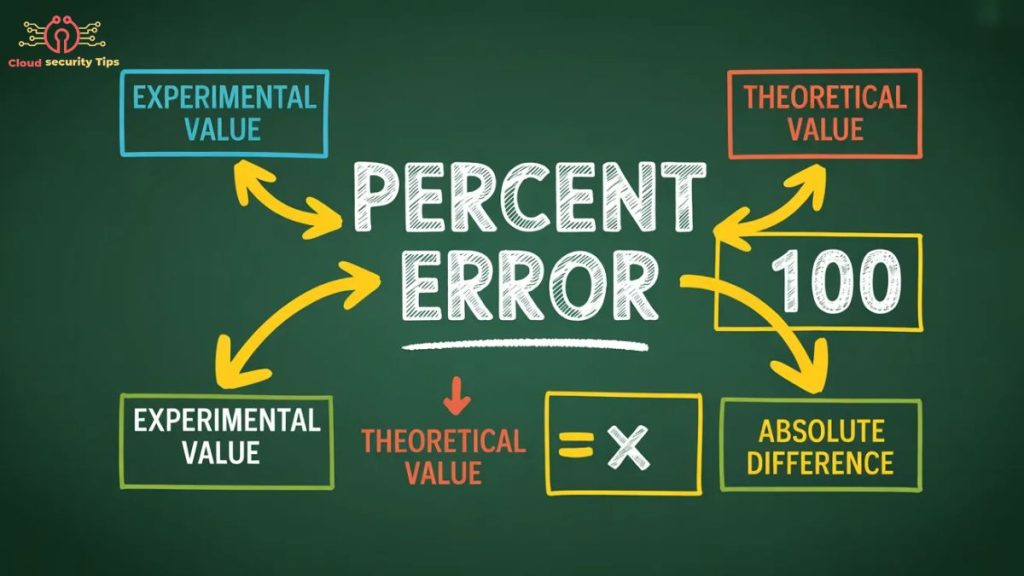
The percent error formula compares experimental and theoretical values:
Percent error is calculated by taking the absolute difference between the experimental and theoretical values, dividing that difference by the theoretical value, and then multiplying the result by 100 to express it as a percentage.
The absolute value ensures the result is always positive, since only the size of the error matters, not its direction.
The theoretical value is used as the reference because it represents the correct or accepted value.
Quick Definition
Percent error is the absolute difference between experimental and theoretical values divided by the theoretical value, multiplied by 100.
Understanding the Core Components
To fully understand percent error, you need to know what each part represents.
The experimental value is the measured result obtained during an experiment.
The theoretical value is the accepted or true value used as a reference.
The difference between these values determines how accurate the result is.
Absolute, Relative, and Percent Error
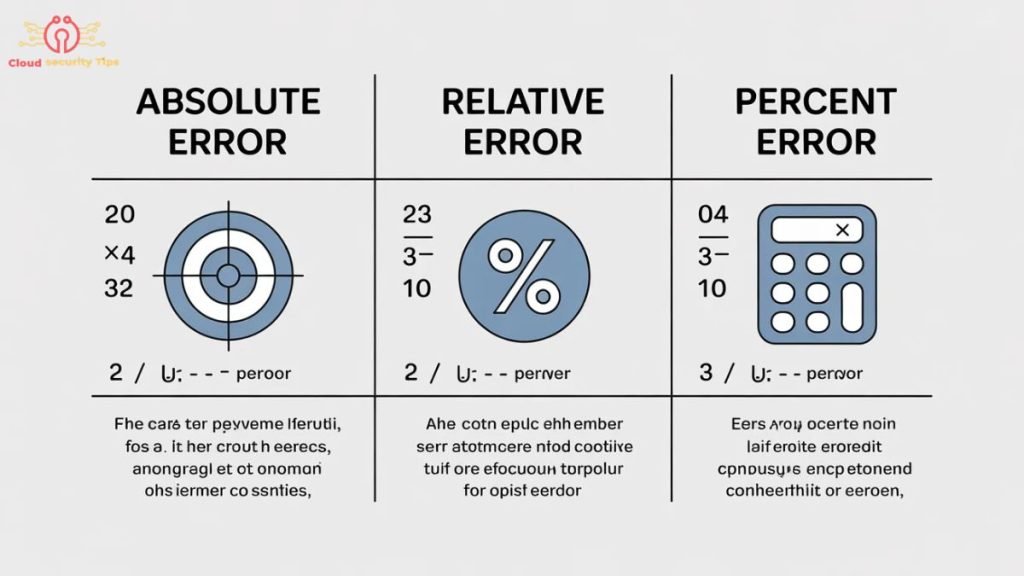
| Type of Error | Formula | What It Shows |
| Absolute Error | |Experimental − Theoretical| | Raw difference |
| Relative Error | Absolute Error ÷ Theoretical | Scaled difference |
| Percent Error | Relative Error × 100 | Percentage accuracy |
This comparison makes it clear that percent error is simply the final, standardized form of error measurement.
Absolute Error Explained
Absolute error is the simplest way to measure error.
Absolute Error = |Experimental − Theoretical|
It shows how far the measured value is from the true value in actual units.
For example, if the actual weight is 100 grams and your measurement is 102 grams, the absolute error is 2 grams.
Relative Error Explained
Relative error improves on absolute error by putting the difference into context.
Relative error is obtained by dividing the absolute error by the theoretical value, which shows the error as a proportion of the true reference value.
This makes it easier to compare errors across different sizes.
For example, an error of 2 grams is significant for a 10-gram object but negligible for a 1000-gram object.
Step-by-Step Calculation
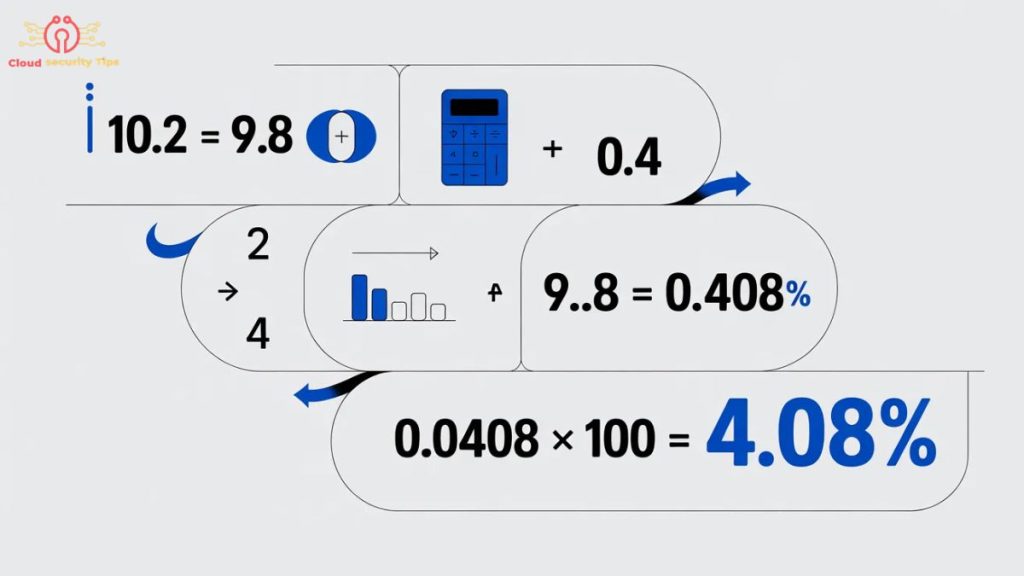
Calculating percent error follows a simple logical process.
Start by identifying the experimental value and the theoretical value.
Start by finding the difference between the experimental value and the theoretical value, then apply absolute value to remove any negative sign so only the size of the error remains.
Divide this result by the theoretical value.
Finally, multiply by 100 to convert it into a percentage.
This method ensures consistent and accurate calculations every time.
Example with Full Explanation
Suppose the accepted value of gravity is 9.8 m/s², but your experiment gives 10.2 m/s².
First, find the difference:
|10.2 − 9.8| = 0.4
Then divide by the theoretical value:
0.4 ÷ 9.8 = 0.0408
Finally, convert to percentage:
0.0408 × 100 = 4.08%
The result shows a small error, meaning the experiment is fairly accurate.
Real-World Applications

Percent error is not limited to textbooks.It plays an essential role in practical, real-world applications where accurate measurement, evaluation, and decision-making are required.In engineering, it ensures systems function correctly within safe limits.
In manufacturing, it helps maintain product quality and consistency.
In data science, it measures how accurate predictions are compared to actual results.
In scientific research, it validates experimental outcomes and improves reliability.
Even in daily life, it can be used when comparing expected and actual results.
Important Edge Cases
There are situations where percent error behaves differently.
If the experimental value equals the theoretical value, the percent error becomes zero, indicating perfect accuracy.
If the theoretical value is very small, even a small difference can produce a very large percent error. This often leads to misinterpretation if not understood properly.
Common Mistakes to Avoid
One of the most common errors is forgetting to use absolute value, which can lead to negative results.
Another mistake is using the wrong denominator. The theoretical value must always be used for accurate calculation.
Mixing units is another issue. Both values must be in the same unit before calculating.
Percent Error vs Percent Change
These two concepts are often confused but are completely different.
| Concept | Purpose |
| Percent Error | Measures accuracy vs true value |
| Percent Change | Measures change over time |
Percent error compares measured results to a known value, while percent change compares values over time.
Why Percent Error is Important
Percent error provides a standardized way to measure accuracy.
Without it, comparing results from different experiments would be difficult. Raw differences alone do not give meaningful insights.
It helps improve measurement techniques, identify errors, and ensure reliable results across scientific and technical fields.
FAQs
What is a good percent error?
A value below 1% is considered highly accurate. Values between 1% and 5% are generally acceptable, while values above 10% indicate significant error.
Can percent error be negative?
No, percent error is always positive because it uses absolute value.
Why is the theoretical value used in the formula?
Because it represents the correct reference point for comparison.
Can percent error be greater than 100%?
Yes, if the difference between values is larger than the theoretical value.
What causes high percent error?
Measurement mistakes, faulty equipment, or incorrect assumptions can all lead to high percent error.
Key Insight
Percent error is more than just a formula. It is a complete system for measuring accuracy.
It takes a raw difference, standardizes it, and turns it into a meaningful percentage that can be compared across different fields.
That is why it remains one of the most widely used tools in science, engineering, and data analysis.