
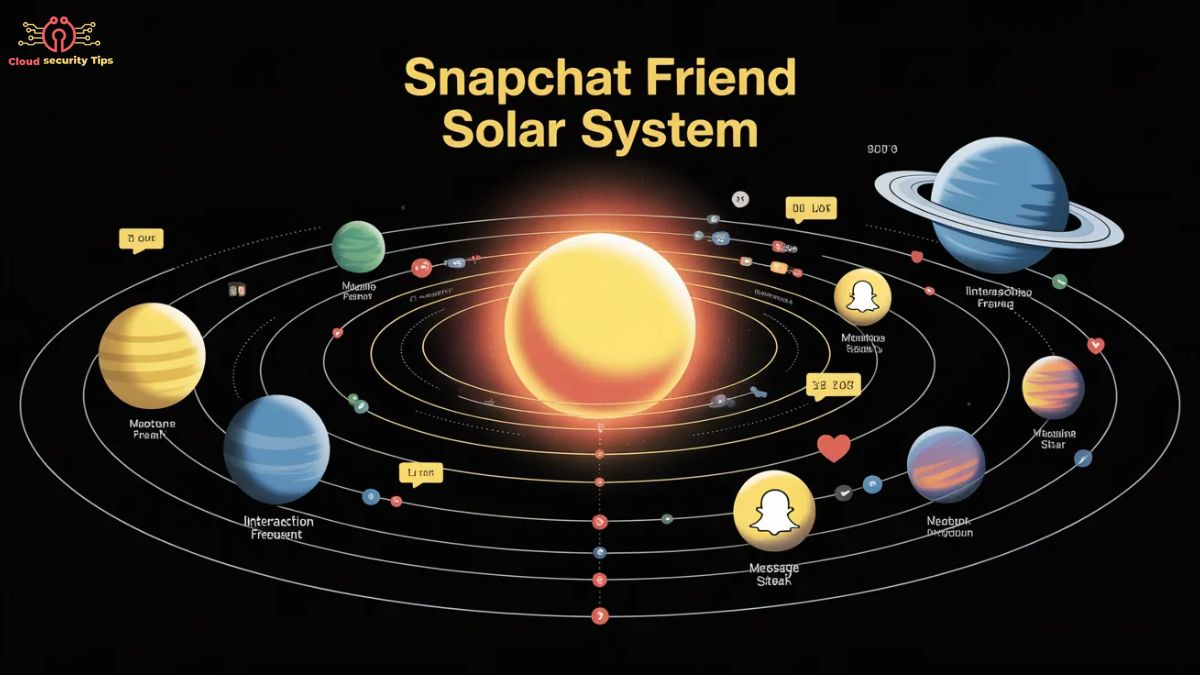
Most explanations of the Snapchat Friend Solar System fail at the same point: they treat it like a cute feature instead of what it actually is—a behavioral ranking algorithm wrapped in a visual metaphor. That misunderstanding is exactly why users end up overthinking it, misreading relationships, and drawing emotional conclusions from something that is not designed to reflect real social depth.
This breakdown is not a surface explanation. It is a structured semantic map of how the feature works, what user intent it serves, where it breaks down, and why most interpretations of it are technically wrong.
The Real Topical Map Behind This Feature (How Information Actually Connects)
Before going into definitions, you need to understand how this topic is logically structured. Most content online jumps from definition to planets to “how to enable,” but that ignores how users actually search and understand the feature.
The real information architecture looks like this:
At the core sits the Snapchat Friend Solar System as a behavioral ranking model. Everything else branches out from it.
From that core, user intent splits into five distinct paths:
One path is pure understanding—what the system is and how it translates interaction data into ranked positions.
Another is mechanical curiosity—how Snapchat calculates rankings and what signals influence position changes.
A third is interpretive confusion—users trying to map emotional meaning onto algorithmic output.
A fourth is action-based intent—how to enable, access, or fix the feature.
The fifth is evaluative intent—whether the system is accurate, useful, or misleading.
If you don’t separate these intents, you end up mixing emotional assumptions with technical behavior. That’s where misunderstanding begins.
Now let’s build the system properly.
What the Snapchat Friend Solar System Actually Is (Not the Simplified Version You Keep Seeing)
The Snapchat Friend Solar System is a premium feature inside Snapchat+ that converts interaction data between two users into a ranked visual model using planetary positions.
That sounds simple, but the key detail most explanations ignore is this:
It does not measure friendship. It measures interaction frequency patterns over time between two accounts.
That distinction is not cosmetic. It changes everything.
The system assigns a user a position in someone else’s “top eight interaction list” and maps that position onto a planetary hierarchy. Mercury represents the highest interaction density. Neptune represents the lowest within that top segment.
This is not emotional ranking. It is not social value. It is not relationship depth. It is behavioral weighting disguised as a symbolic structure.
If you treat it as anything else, your interpretation will drift away from reality.
Why This Feature Exists (The Product Logic No One Talks About)
Snapchat is not trying to “rank your friends.” That’s the surface story.
The real product logic is retention through feedback loops.
When users see shifting positions, they are encouraged to:
- open the app more often
- interact more frequently
- monitor changes
- compare behavior patterns
That creates a behavioral loop where users unconsciously optimize their engagement to maintain or improve position.
This is not accidental. It is a standard engagement design pattern used in social platforms, where visibility of relative ranking increases usage frequency.
The planetary metaphor is just packaging. The real product is behavioral reinforcement.
How the Ranking System Actually Works (Mechanics Behind the Curtain)
The system evaluates interaction signals continuously. But it does not treat all signals equally.
There are three dominant dimensions:
First is frequency. How often two users interact over a defined period.
Second is consistency. Whether interaction happens regularly or in bursts.
Third is recency. Recent activity carries more weight than older interaction history.
What matters most is not volume, but stability over time.
This is where most users misread the system. A short period of intense messaging does not guarantee a high rank. Likewise, a strong past connection decays if interaction slows.
The system behaves more like a rolling behavioral window than a cumulative score.
That alone invalidates most assumptions people make about “why someone is ranked higher than me.”
The Planet Hierarchy (What Each Position Actually Represents)
The planetary model is not random decoration. It is a structured gradient of interaction strength.
Mercury represents the most active and consistently reciprocal interaction pattern.
Venus and Earth represent strong but slightly less stable engagement.
Mars sits in mid-level interaction territory where communication exists but lacks consistency or balance.
Jupiter and Saturn represent weaker but still active interaction traces.
Uranus and Neptune sit at the edge of measurable engagement within the top eight threshold.
But here is the uncomfortable truth: these labels do not describe emotional closeness. They describe algorithmic density of interaction signals.
If you interpret Neptune as “least important friend,” you are making a category error. The system never claims importance. It only ranks behavior.
Why Only Eight Positions Exist (Intentional Constraint, Not Limitation)
Limiting the system to eight positions is not arbitrary.
It forces compression of social interaction into a small comparative frame. That increases competitive perception.
If the system expanded to dozens of positions, it would lose psychological impact. Users would stop caring about small changes.
By restricting it to eight, Snapchat ensures that small behavioral shifts feel meaningful.
This is a design decision aimed at maintaining attention, not reflecting social reality.
The Snap Score Confusion (Where Most Interpretations Collapse)
One of the most persistent misunderstandings is linking Snap Score to Solar System ranking.
That assumption is incorrect.
Snap Score is a global activity metric. It reflects total platform usage behavior.
The Solar System is relational. It measures interaction between two specific users only.
You can have a high Snap Score and still rank low in someone else’s system if your direct interaction with that person is weak or inconsistent.
Confusing these two systems leads to false conclusions about social standing.
Snapchat+ and Access Control (Why This Feature Is Not Universal)
The Solar System is not part of the standard Snapchat experience. It is locked behind Snapchat+.
That matters because it changes interpretation context.
This is not a “core social graph feature.” It is an experimental analytics layer packaged as premium insight.
The restriction also increases perceived value. Scarcity makes users assign more meaning to rankings than they objectively deserve.
If you are analyzing this feature as if it is a universal social truth, you are already misframing it.
Misinterpretations Users Keep Making (And Why They Fail)
The biggest error is emotional projection.
Users assume:
- higher rank means deeper friendship
- lower rank means reduced importance
- position changes reflect relationship changes
None of that is guaranteed.
The system does not evaluate emotional depth, loyalty, or offline interaction. It only tracks digital behavior signals.
Another error is assuming stability. Rankings are dynamic. They shift based on short-term behavioral changes.
A third mistake is over-analysis. Users try to reverse-engineer meaning from fluctuations that are statistically normal in any engagement-based system.
If you are reading emotional narratives into this data, you are overfitting meaning onto noise.
How to Enable and Access It (Functional Intent Layer)
From a functional standpoint, access requires Snapchat+ activation.
Once enabled, the feature appears inside friendship profiles. Users can open a contact profile and view their assigned planetary position in that person’s system.
However, availability is inconsistent due to rollout variations, version dependencies, and account-level activation delays.
If the feature is missing, it is not a mystery. It is either subscription status, app version, or feature flag distribution.
There is no hidden “unlock trick.” That idea is usually misinformation.
Troubleshooting Reality (Why People Think It Is Broken)
Most “issues” fall into three categories:
Feature not visible due to subscription status.
App version mismatch causing UI elements not to load.
Misinterpretation of what the system is actually showing.
The most common failure is expectation mismatch. Users expect emotional accuracy. The system delivers behavioral approximation.
That gap creates the illusion of error.
Is the System Accurate? The Real Answer
If you define accuracy as “does it correctly measure interaction frequency patterns,” then yes, it performs its function.
If you define accuracy as “does it reflect real friendship strength,” then no, it fails completely.
That distinction matters more than most people want to admit.
The system is mathematically consistent but socially incomplete.
It does not see context. It does not see intent. It does not see offline relationships.
It only sees interaction traces.
Psychological Impact (What This Feature Actually Changes in Behavior)
The Solar System does something subtle but powerful: it turns private interaction patterns into perceived competition.
Even though it is framed as informational, users interpret it emotionally.
That leads to behavioral changes such as:
increased messaging frequency to maintain rank
reduced communication anxiety based on position
misinterpretation of natural interaction decay
social comparison based on algorithmic output
This is where the feature becomes less about information and more about behavioral influence.
Whether that is beneficial depends on how consciously the user interprets it.
Comparison: Snap Score vs Solar System (Why They Are Not Equivalent)
Snap Score is aggregate activity.
Solar System is relational ranking.
Snap Score is broad and non-comparative.
Solar System is narrow and comparative.
One describes platform usage. The other describes interaction density between two users.
Treating them as interchangeable leads to completely wrong conclusions.
Final Evaluation (What You Should Actually Take From This)
The Snapchat Friend Solar System is not a friendship map. It is not a social truth system. It is a behavioral visualization layer built on interaction frequency, consistency, and recency.
It compresses complex communication behavior into a simplified hierarchy using planetary symbolism.
That makes it easy to understand but easy to misinterpret.
If you treat it as a reflection of real relationships, you will overestimate its meaning.
If you treat it as a behavioral analytics tool, it becomes useful.
The difference is not in the feature. The difference is in how seriously you choose to interpret it.
1 thought on “Snapchat Friend Solar System Explained”