
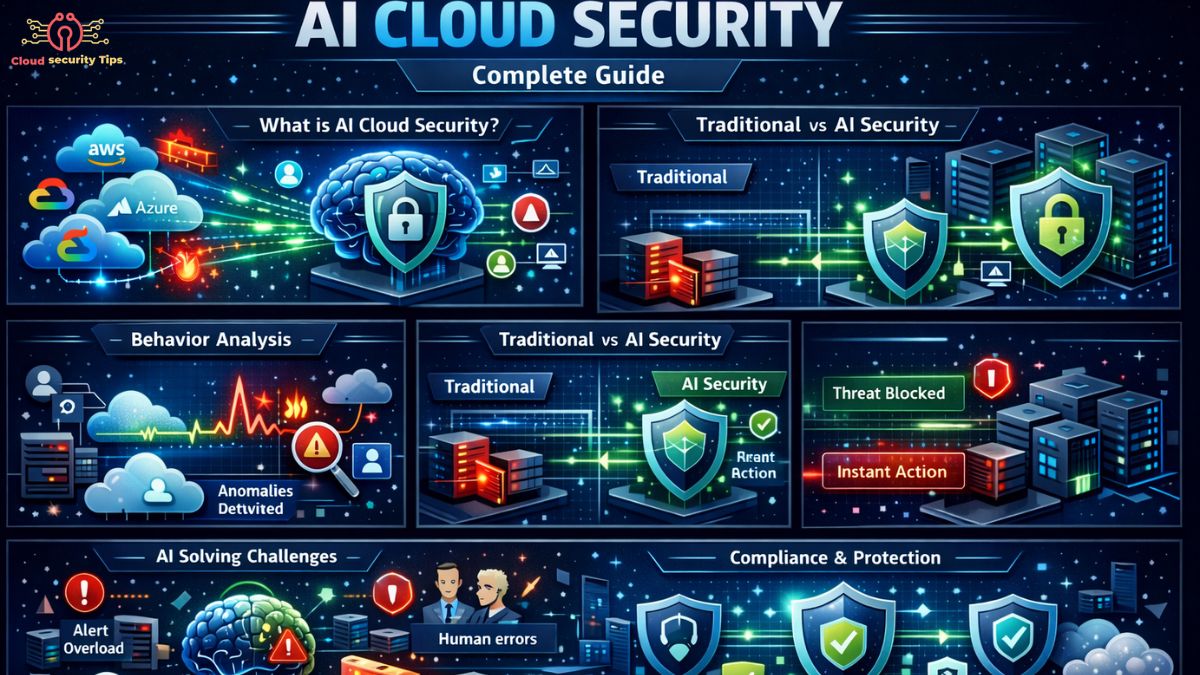
AI cloud security is a modern cybersecurity approach that combines Artificial Intelligence (AI) with cloud computing to protect data, applications, and digital systems from increasingly sophisticated cyber threats. As organizations rapidly shift toward cloud-based infrastructure, the need for intelligent and automated security systems has become more critical than ever.
Today, most businesses rely on platforms like Amazon Web Services, Microsoft Azure, and Google Cloud to store and manage sensitive data. While these platforms offer scalability, flexibility, and performance, they also introduce new security risks due to their complex and dynamic nature.
AI cloud security addresses these challenges by transforming traditional security systems into intelligent frameworks that can detect, analyze, and respond to threats in real time. Instead of reacting after damage is done, AI enables organizations to prevent attacks before they escalate.
What Is AI Cloud Security?
AI cloud security refers to the use of artificial intelligence and machine learning technologies to automatically secure cloud environments. It enables systems to continuously monitor user behavior, network activity, and system processes without requiring constant human intervention.
How AI Understands Cloud Behavior
In a cloud environment, thousands of actions occur every second, including user logins, API requests, data transfers, and configuration updates. AI systems observe these activities over time and build a behavioral baseline.
Once this baseline is established, the system can quickly detect anomalies. For example, if a user suddenly accesses large volumes of data at an unusual time or from a different location, AI identifies this as suspicious and can trigger immediate action.
Difference Between Traditional Security and AI-Based Security
Conventional security systems depend on fixed rules and known signatures to identify threats. While effective in known scenarios, they often fail to detect new or evolving threats. AI, on the other hand, adapts continuously by learning from data patterns, making it far more effective against modern cyber attacks.
How AI Is Transforming Cloud Security
AI has significantly changed the way organizations approach cloud security by shifting from reactive defense mechanisms to proactive threat prevention.
Real-Time Threat Detection
AI systems analyze vast amounts of data in real time, enabling them to identify threats instantly. This reduces the time attackers have to exploit vulnerabilities and minimizes potential damage.
Intelligent Decision-Making
Unlike traditional systems that only generate alerts, AI can evaluate the severity of a threat and decide the best course of action. This may include blocking access, isolating systems, or triggering additional authentication.
Automated Incident Response
One of the greatest strengths of AI is its ability to automate complex processes. Security incidents can be handled immediately without waiting for human intervention, which is crucial in high-risk environments.
Key Challenges in Cloud Security That AI Solves
Cloud environments are complex and constantly evolving, which introduces several security challenges. AI plays a crucial role in resolving these challenges.
Human Error and Alert Overload
Security teams often deal with thousands of alerts daily, many of which are false positives. AI filters out unnecessary alerts and prioritizes real threats, allowing teams to focus on what truly matters.
Dynamic and Changing Infrastructure
Cloud systems are not static. New services, configurations, and permissions are continuously added or modified. AI tracks these changes in real time and identifies potential risks before they become serious vulnerabilities.
Evolving Cyber Threats
Modern attackers are using advanced techniques, including automation and AI, to launch sophisticated attacks. AI-powered security systems can detect these threats early and respond faster than traditional tools.
Core AI Capabilities in Cloud Security
AI enhances cloud security through several advanced capabilities that improve detection, response, and overall system resilience.
Threat Detection and Behavioral Analysis
AI monitors user and system behavior across the cloud environment. By identifying patterns and deviations, it can detect hidden threats that would otherwise go unnoticed.
Cloud Configuration Monitoring
Cloud misconfigurations remain one of the most common causes of data breaches in modern environments..AI continuously audits cloud settings and provides recommendations to fix vulnerabilities before they are exploited.
Identity and Access Management Optimization
AI evaluates access patterns and identifies unnecessary or risky permissions. This helps organizations implement the principle of least privilege and reduce the risk of unauthorized access.
Risk-Based Prioritization
Not all security issues have equal levels of risk or impact.. AI assesses vulnerabilities based on their potential impact and likelihood of exploitation, helping teams address the most critical threats first.
AI in Cloud Security Compliance
Compliance with global security standards is a major concern for organizations operating in the cloud.AI streamlines this process by automating monitoring and generating real-time reports.
Continuous Compliance Monitoring
AI systems continuously scan cloud environments to ensure they meet regulatory requirements such as GDPR, HIPAA, and SOC 2. This eliminates the need for manual audits and reduces the chances of human error.
Automated Reporting and Alerts
When a compliance violation is detected, AI generates real-time alerts and detailed reports. This allows organizations to take immediate corrective action and maintain compliance at all times.
Securing AI Workloads in the Cloud
As AI systems themselves run on cloud infrastructure, securing these workloads becomes equally important.
Data Integrity and Protection
AI models rely heavily on training data. Ensuring the integrity and confidentiality of this data is essential to maintain accurate and reliable outputs.
Encryption and Model Security
Sensitive data and AI models should be encrypted both in transit and at rest. This prevents unauthorized access and protects against data theft or reverse engineering.
Secure Execution Environments
Running AI workloads in isolated environments reduces exposure to external threats. Confidential computing techniques can further enhance security by protecting data during processing.
Strong Data Governance Policies
Organizations must implement strict data governance policies to ensure that only high-quality and trusted data is used in AI systems. Poor or manipulated data can lead to incorrect decisions and security risks.
Challenges of Implementing AI in Cloud Security
Despite its advantages, AI cloud security comes with its own set of challenges that organizations must address.
Data Privacy Concerns
AI systems require large amounts of data, which may include sensitive information.Maintaining data privacy and complying with protection regulations is essential for secure operations.
Integration with Legacy Systems
Many organizations still rely on outdated infrastructure, which may not be compatible with modern AI solutions. This creates challenges during implementation.
High Costs and Resource Requirements
Deploying AI-based security systems can be expensive, especially for small and medium-sized businesses.
Skill Gap in Cybersecurity and AI
There is a growing demand for professionals who understand both cybersecurity and AI, making it difficult for organizations to find qualified talent.
Best Practices for AI Cloud Security
To fully benefit from AI cloud security, organizations should follow a strategic and balanced approach.
Combining AI with Human Expertise
AI should not replace humans but work alongside them. Human oversight ensures better decision-making and reduces the risk of errors.
Implementing a Zero Trust Model
A zero trust approach ensures that every access request is verified, regardless of its origin. This significantly enhances overall security.
Continuous Monitoring and Testing
Regular monitoring and simulated attack testing help identify weaknesses and improve system resilience.
Using Advanced Security Tools
Integrating AI with tools such as SIEM, CSPM, and XDR creates a layered security approach that provides comprehensive protection.
Future of AI Cloud Security
The future of AI cloud security is driven by automation, intelligence, and predictive capabilities.
Predictive Threat Intelligence
AI systems will not only detect threats but also predict them before they occur, allowing organizations to take preventive measures.
Fully Automated Security Operations
Security operations centers will become highly automated, reducing manual workload and improving efficiency.
Smarter and Adaptive Systems
Future AI systems will continuously learn and adapt to new threats, making them more effective over time.
Conclusion
AI cloud security represents the future of cybersecurity in cloud environments. It offers a powerful combination of speed, intelligence, and scalability, enabling organizations to protect their digital assets more effectively.
However, the most effective security strategies are those that combine AI-driven automation with human expertise. This balanced approach ensures not only strong protection but also long-term resilience in an ever-evolving threat landscape.
FAQs
What is AI cloud security in simple terms?
AI cloud security is the use of artificial intelligence to automatically monitor, detect, and respond to security threats in cloud environments without constant human intervention.
How does AI improve cloud security?
AI improves cloud security by analyzing user behavior, detecting unusual activities in real time, reducing false alerts, and automatically responding to potential threats.
What are the main benefits of AI in cloud security?
The main benefits include faster threat detection, automated response, reduced human error, improved compliance, and better risk management.
What challenges does AI cloud security face?
AI cloud security faces challenges such as data privacy concerns, high implementation costs, integration issues with legacy systems, and false positives.
Is AI cloud security suitable for small businesses?
Yes, small businesses can use AI cloud security, especially through cloud-based security tools that offer scalable and cost-effective solutions.
What is the future of AI in cloud security?
The future of AI in cloud security includes predictive threat detection, fully automated security systems, and smarter tools that can prevent attacks before they happen.